
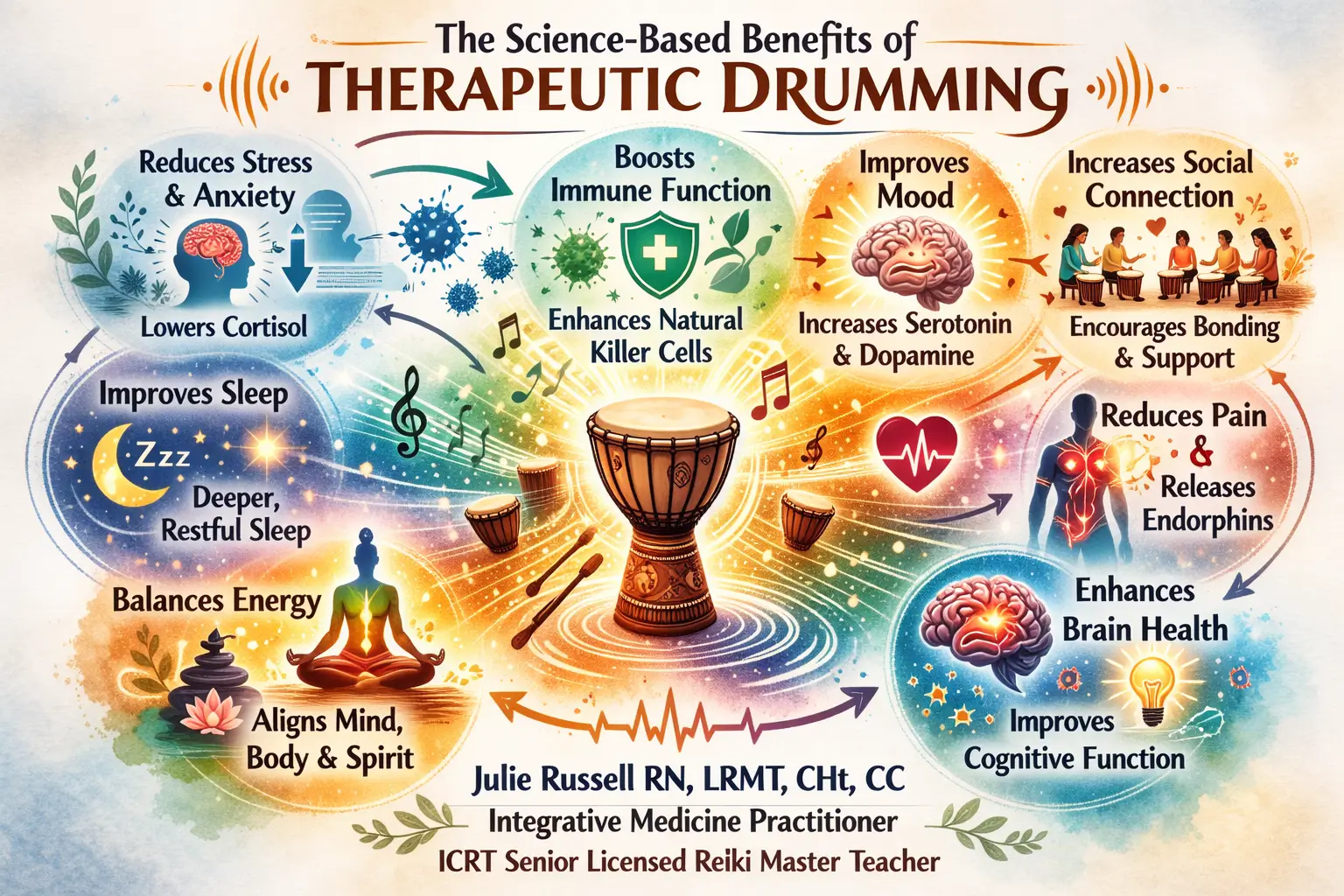
By Julie Russell RN, LRMT, CHt, CC
Founder, Master Teacher Sacred Reiki Drumming Certification™
Remo Certified Therapeutic Drumming Practitioner®
For thousands of years, rhythmic drumming has been used across cultures as a tool for healing, regulation, connection, and transformation. Today, modern neuroscience and psychophysiology are beginning to confirm what ancient traditions have long understood — rhythm has a powerful effect on the brain, nervous system, body, and emotional well-being.
For over the past 15 years, I have integrated therapeutic drumming into private sessions, classes, and hospital settings — both with and without Reiki. Again and again, I have witnessed how rhythm gently guides people into deep states of relaxation, emotional release, connection, and healing.
Below are key therapeutic benefits of drumming supported by neuroscience research and clinical experience.
Nervous System Regulation & Stress Reduction
Rhythmic auditory stimulation entrains autonomic nervous system activity, promoting parasympathetic (rest-and-restore) dominance and reducing sympathetic overactivation.
Research findings include:
- Reduced cortisol levels (Bittman et al., 2001)
- Improved autonomic balance and relaxation response
- Reduced anxiety and physiological stress markers
Drumming rhythm stabilizes breathing, heart rate, and vagal tone, supporting nervous system regulation.
Brainwave Entrainment & Meditative States
Repetitive rhythmic stimulation can synchronize neural firing patterns and influence brainwave activity (Large & Snyder, 2009; Thaut, 2005).
Drumming has been associated with:
- Increased alpha activity (relaxed awareness)
- Increased theta activity (deep meditative processing, emotional integration)
- Enhanced neural coherence and synchronization
- Occasional gamma coherence in advanced meditative or integrative states
These brain states are associated with meditation, emotional processing, memory integration, and trauma resolution.
Emotional Release, Pain Reduction & Mood Regulation
Rhythmic group drumming has demonstrated effects on mood, pain perception, and emotional processing through neurochemical and neurophysiological pathways.
Research shows:
- Increased endorphin release (Dunbar et al., 2012)
- Reduced perceived pain
- Improved mood and emotional expression
- Reduction in anxiety and depressive symptoms
- Increased dopamine and serotonin activity associated with rhythmic engagement
Drumming offers a nonverbal pathway for emotional discharge and regulation.
Immune System & Physiological Effects
Group drumming has been shown to influence immune function and inflammatory markers. The interaction between rhythm, stress reduction, and neuroimmune pathways is significant.
Notable findings:
- Increased natural killer (NK) cell activity (Bittman et al., 2001)
- Improved immune regulation
- Reduction in stress-related immune suppression
Group Cohesion, Social Bonding & Reduction of Isolation
Neuroscience research shows synchronized rhythmic activity promotes interpersonal neural and physiological coherence (Koelsch, 2010; Dunbar, 2012).
Group drumming supports:
- Increased oxytocin and social bonding
- Reduction in perceived isolation and disconnection
- Improved social engagement and emotional responsiveness
- Increased empathy and interpersonal synchronization
In clinical and hospital settings, I have repeatedly observed that even individuals who are confused, disoriented, withdrawn, or socially isolated begin to reconnect and engage when rhythm is introduced, often within minutes. This has been seen hundreds of times in my clinical reiki practice and within outpatient hospital environments.
Trauma Regulation & Neural Integration
Rhythmic stimulation engages subcortical brain regions involved in emotional regulation, including limbic and sensorimotor systems (van der Kolk, 2014; Porges, Polyvagal Theory).
Observed and research-supported effects include:
- Nervous system stabilization
- Reduced hyperarousal and dissociation
- Improved emotional regulation
- Enhanced sense of safety and grounding
Rhythm appears to help integrate fragmented neural processing often seen in trauma states. Bi-lateral drum beats are now often used when clients are doing EMDR sessions.
The Added Dimension of Reiki Drumming
When Reiki is combined with drumming, rhythm interacts with a coherent healing field that appears to deepen nervous system regulation, emotional balance, and subjective well-being.
Commonly reported experiences include:
- Release of anxiety and muscular tension
- Deep relaxation and inner stillness
- Emotional release and energetic balance
- Heightened awareness and intuitive clarity
- A sense of coherence and connection
The drum functions not only as rhythmic stimulation, but as a carrier for healing intention and regulatory coherence.
My Clinical Experience and Observations in working with clients using drumming for over 15 Years
Across private sessions, classes, and hospital environments, therapeutic drumming with and without Reiki has consistently shown itself to be:
- Nervous system regulating
- Pain reducing (physical and emotional)
- Mood stabilizing
- Connection-building
- Trauma-supportive
- Deeply calming and grounding
Many individuals who struggle with traditional meditation find rhythm provides a natural, accessible doorway into stillness and regulation.
Final Reflection
The drum speaks directly to the nervous system, the brain, and the deeper biological rhythms of human experience. Neuroscience increasingly supports what healers have long observed, rhythm regulates, connects, and heals.
After over 15 years of clinical use, therapeutic drumming continues to demonstrate its remarkable ability to help individuals move from stress to regulation, from isolation to connection, and from dysregulation to coherence.
The rhythm is simple.
The effects are profound.
And healing often unfolds naturally from there.
Selected Neuroscience & Clinical References
Bittman, B. B. et al. (2001). Composite effects of group drumming on immune and emotional states. Alternative Therapies in Health and Medicine.
Dunbar, R. I. M. et al. (2012). Performance of music elevates pain threshold and positive affect: Implications for the evolutionary function of music. Evolutionary Psychology.
Koelsch, S. (2010). Towards a neural basis of music perception — A review and updated model. Frontiers in Psychology.
Large, E. W., & Snyder, J. S. (2009). Pulse and meter as neural resonance. Annals of the New York Academy of Sciences.
Thaut, M. H. (2005). Rhythm, music, and the brain: Scientific foundations and clinical applications.
van der Kolk, B. (2014). The Body Keeps the Score: Brain, Mind, and Body in the Healing of Trauma.
Porges, S. W. (Polyvagal Theory). Autonomic regulation and social engagement.
